Earlier work, no longer maintained. Kept online as a reference for research and teaching; some demos may not run in current browsers.
Small single-purpose apps from the first years of the lab, many made by master students. Most still run in the browser.
-
2013
A simple parametric design of an anchor handling tug supply vessel: from mission requirements to capabilities, sizing, criteria checks and a summary of the design.
The first of the web apps
Henrique M. Gaspar, with Ulstein International.
-
2014
Epoch-era analysis of LNG-fuelled and conventional ships on Arctic routes under changing ice, rules and markets, comparing designs on CAPEX, OPEX and emissions. Presented at OMAE 2014.
Henrique M. Gaspar, with Ulstein International.
-
2014
Interactive web visualisations of conceptual ship design data with the D3.js library, to help designers and stakeholders find knowledge early in the design. Presented at COMPIT 2014.
Henrique M. Gaspar, Per Olaf Brett, Ali Ebrahim and Andre Keane.
-
2015
Proof of concept for layouts in conceptual design: blocks read from a CSV file are placed on a grid, with their neighbours and connections shown in a connection wheel.
Henrique M. Gaspar, with the naval architecture group at UCL.
-
2015, updated 2024
Heave, pitch, roll, vertical acceleration and wave bending moment from the main dimensions, with the closed-form expressions of Jensen, Mansour and Olsen (2004).
Sthefano L. Andrade and Henrique M. Gaspar. Updated by Gaël Porée and Maxime Albouy (SeaTech, Toulon).
-
2015
Animated linear roll and heave of a barge-like vessel in still water, with a moving-liquid tank.
Thiago G. Monteiro, Jiafeng Xu and Henrique M. Gaspar.
-
2016
Two tanks joined by a pipe, with an optional pump: water levels and flow rate over time.
Thiago G. Monteiro, Synnøve Nesdal Sandnes and Henrique M. Gaspar.
-
2016
Lines plan and 3D hull plotted from a table of offsets in CSV, with a patrol craft and a fishing boat as examples.
Jefferson Flor and Henrique M. Gaspar.
-
2016
Resistance of a displacement ship by the Holtrop method, split into frictional, form, appendage, wave, bulb, transom and correlation parts.
Jefferson Flor, Thiago G. Monteiro and Henrique M. Gaspar.
-
2016
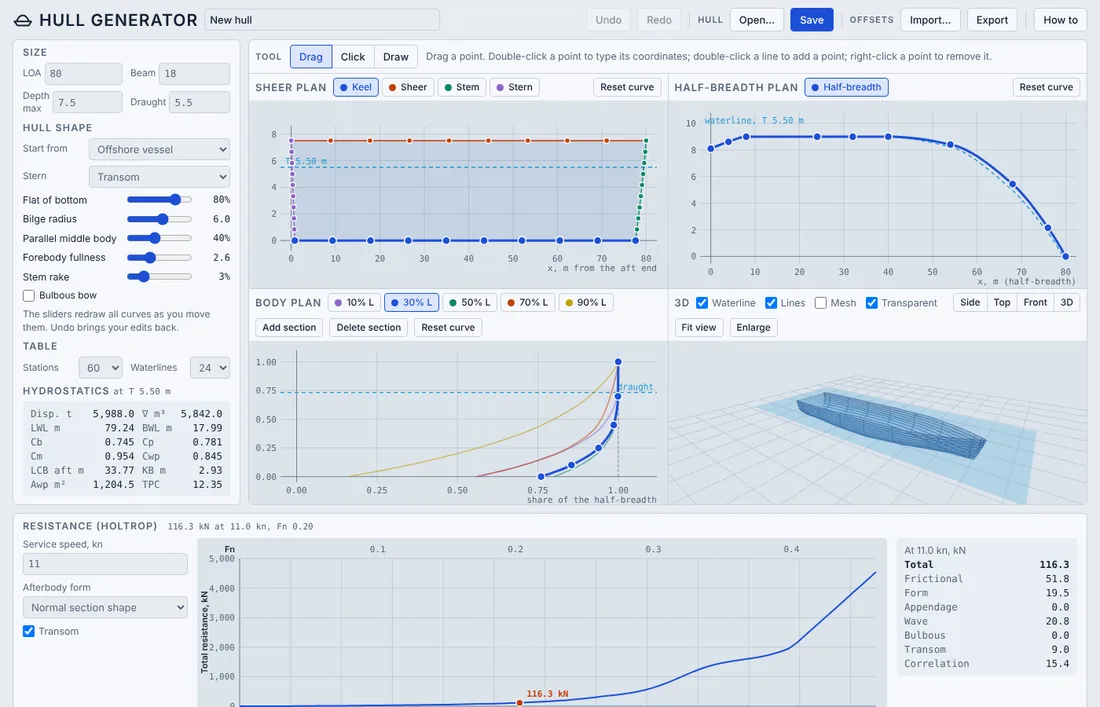
Parametric hull lines from the main dimensions, inspired by X-bow offshore vessels. Curves that fail validation turn red.
Thiago G. Monteiro and Henrique M. Gaspar.
-
2016
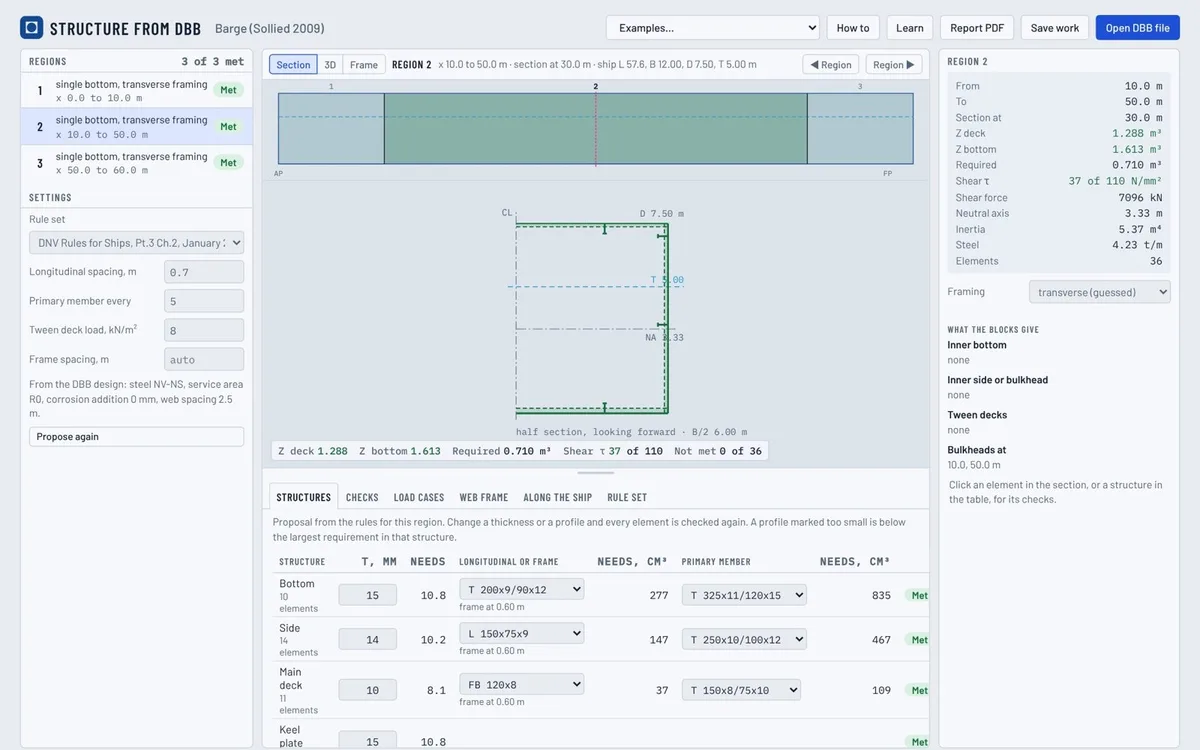
Load distribution, shear force and bending moments to DNV rules, and sizing of longitudinal stiffeners.
Sthefano L. Andrade.
-
2016
Real-time 3D simulator of a ship virtual prototype: choose the bow, accommodation, propulsion and crane operation, then set the waves and motions.
DNV GL COMPIT Award 2016
Olivia Chaves, Elias Hasle and Henrique M. Gaspar.
-
2018
Hull girder loads to DNV GL rules and a hull girder strength check, from the operating profile, main dimensions and cross-sections. Presented at ICSOS 2018.
Olivia Chaves (master thesis), supervised by Henrique M. Gaspar and Henning Borgen (SINTEF Ålesund).
-
2019
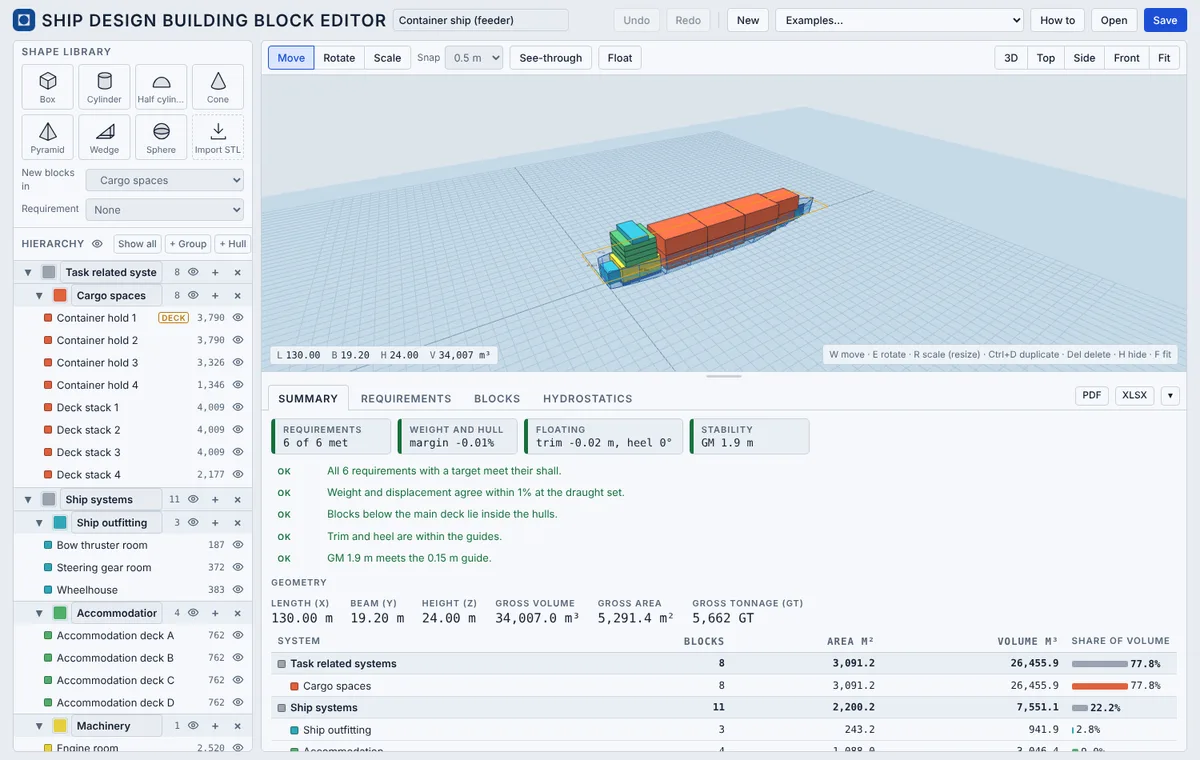
Design Building Block app with a parametric hull, bulkheads and function blocks: hydrostatics and stability, Holtrop resistance and seakeeping. UCL and NTNU.
Diogo Kramel, building on work by Alexander S. Piperakis and Henrique M. Gaspar (2016).